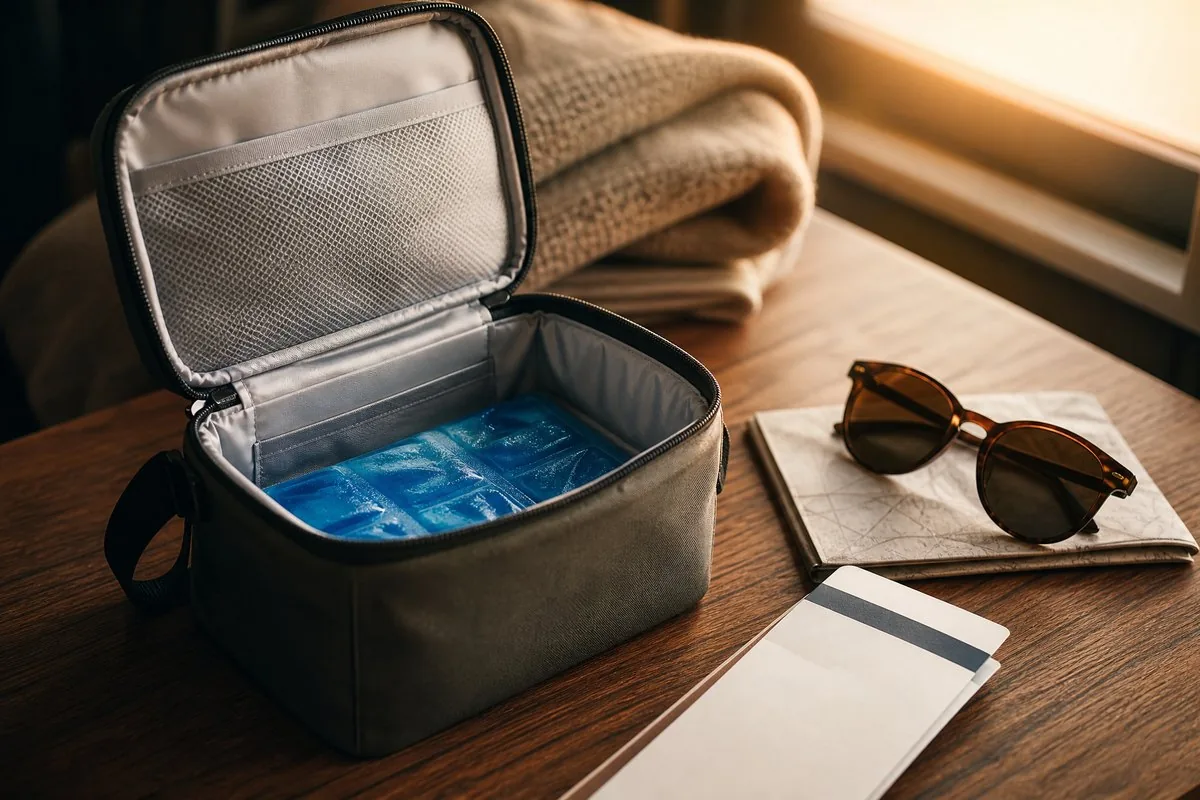
Cold, but not frozen
Refrigeration protects peptide stability. Freezing damages it, and a vial that has frozen should not be used even if it looks normal. The coldest part of a fridge, and the freezer compartment, are both mistakes.
Your label beats every internet rule
How long yours may sit at room temperature, and when to discard it, is set by the pharmacy that prepared it. If a vial has been warm longer than the label allows, call the pharmacy printed on it rather than deciding for yourself.
Flying with it
Medication travels in hand luggage, never in checked baggage where the hold can freeze. Bring it in the pharmacy packaging with the label attached, and use a small insulated case with a gel pack that is cool rather than frozen solid. Security screening is routine for prescribed medication.
Semaglutide acts on the GLP-1 receptor – the same signalling your gut uses after a meal.
Cars, beaches and windowsills
A parked car in summer exceeds safe temperatures within minutes. Direct sun and radiators do the same slowly. If you would not leave chocolate there, do not leave your vial there.
A simple habit that prevents most problems
One dedicated shelf, one cool bag for travel, one glance at the label before every dose. Boring, and it works. See the 30-second film answers for this medication.
Storage, cold chain, and what to do if something goes wrong
Peptide preparations are handled cold because temperature drives degradation over time. Your dispensing pharmacy sets the storage instructions for the exact preparation you receive, and those instructions govern rather than anything written on a website. In general terms, vials are shipped with cold packs, refrigerated on arrival, and kept away from the freezer compartment and direct light. A brief excursion during transit is expected and accounted for; a package that arrives warm to the touch, leaking, cloudy, or visibly damaged is a call to the pharmacy, not a judgement call for you to make. Never use a preparation whose appearance has changed. The same principle applies to travel: plan cold storage before you go rather than improvising, and ask your pharmacy what excursion window applies to your specific vial.
FDA has warned about dosing errors reported with compounded GLP-1 products.
How semaglutide works on the GLP-1 receptor
Semaglutide is a GLP-1 receptor agonist. GLP-1 is an incretin hormone your intestine releases after eating; it prompts insulin release when glucose is elevated, slows gastric emptying, and signals satiety in the hypothalamus. Semaglutide binds the same receptor, and structural modifications give it a long half-life, which is what makes once-weekly dosing possible for the injectable form. It acts on one receptor rather than two, which is the pharmacological difference from tirzepatide. According to the FDA prescribing information for semaglutide products, that mechanism is the basis of the approved indications. Oral semaglutide reaches the same receptor by a different route and carries strict dosing conditions as a result, which oral versus injectable semaglutide covers. Whether any form suits you is decided by a licensed clinician after an evaluation.
What compounded means, and what it does not
A compounded preparation is made by a licensed pharmacy for an individual patient on receipt of a valid prescription. Compounded drugs are not FDA-approved, and FDA does not review them for safety, effectiveness, or quality before they are marketed. That is a statement about regulatory pathway, not an accusation about any particular pharmacy, and it is why the distinction matters more than marketing language does. A compounded preparation is not a generic and not an equivalent of any FDA-approved brand product. Published clinical trials such as STEP-1 studied the branded product at studied doses; those findings should not be assumed to transfer. What compounded means unpacks the legal framework, and red flags when buying online covers how to tell a legitimate pharmacy from a grey-market seller.
Why side effects are mostly digestive, and mostly early
Because the receptors semaglutide acts on sit in the gut and the brainstem, the predictable effects are digestive: nausea, reflux, constipation, diarrhoea, and a feeling of fullness that arrives sooner than expected. According to FDA prescribing information for semaglutide products, gastrointestinal reactions are the most commonly reported adverse events, and they are dose-related for many people. The practical implication is that they tend to cluster around a dose change rather than persist indefinitely. Serious risks are listed separately in the label, including pancreatitis, gallbladder disease, and a boxed warning for thyroid C-cell tumours in rodents. Those are not common, but they are the reason the medication is prescription-only. Report severe or persistent abdominal pain, vomiting that stops you keeping fluids down, or vision changes to your clinician promptly rather than waiting for a scheduled check-in.
About 10 minutes. Full refund if nothing is prescribed.
Frequently asked questions
What if I left it out overnight?
Do not use it and do not guess. Call the pharmacy on your label with how long and how warm.
Can I use a freezer pack directly against the vial?
No. Use a cool pack with a cloth barrier so the vial never touches something frozen.
How do I inject semaglutide?
Follow the instructions supplied with your specific preparation. Weekly peptide injections are generally subcutaneous, into the abdomen away from the navel, the outer thigh, or the back of the upper arm, rotating the site each week. Contact the pharmacy before injecting if anything about your dose or volume is unclear.
Where do you inject semaglutide?
Subcutaneous sites are the abdomen, outer thigh, and back of the upper arm. Rotating between them reduces local irritation. Your dispensing pharmacy provides site guidance for your preparation.
How long do semaglutide side effects last?
Gastrointestinal effects are dose-related for many people, so they commonly cluster around a dose change and settle as the body adapts. Persistent or severe symptoms are a reason to contact your clinician rather than wait.
Are brand-name semaglutide products the same?
Both contain semaglutide, but they are separate FDA-approved products with different approved indications and dosing. Neither is the same as a compounded semaglutide preparation, which is not FDA-approved.
Start with a plan that arrives cold and labelled
Prescribed if appropriate by a licensed clinician, shipped cold-packed. Rx only.
Rx only. A licensed clinician decides whether treatment is appropriate and may determine that no treatment, or a different treatment, is right for you. Compounded medications are not FDA-approved and are not reviewed by FDA for safety, effectiveness, or quality before marketing. Individual results vary.
Sources
Clinical trials listed below evaluated FDA-approved products at the doses studied. They are cited as published science, not as evidence about any compounded preparation, which is not FDA-approved and has not been evaluated by FDA for safety, effectiveness, or quality.
- FDAFDA: Alerts health care providers, compounders and patients of dosing errors associated with compounded semaglutide injectable products
- ReferenceTSA: Traveling with medication
- FDA databaseDrugs@FDA: search approved labeling for semaglutide
- Peer-reviewedSTEP-1: Once-Weekly Semaglutide in Adults with Overweight or Obesity (NEJM 2021)
Spotted something inaccurate? Report an error – corrections are logged per our editorial standards.
More on Compounded Semaglutide
Same medication, different question.



Travel storage is on the pharmacy label, not a forum. If you still need the prescription itself, the visit is compounded semaglutide online.