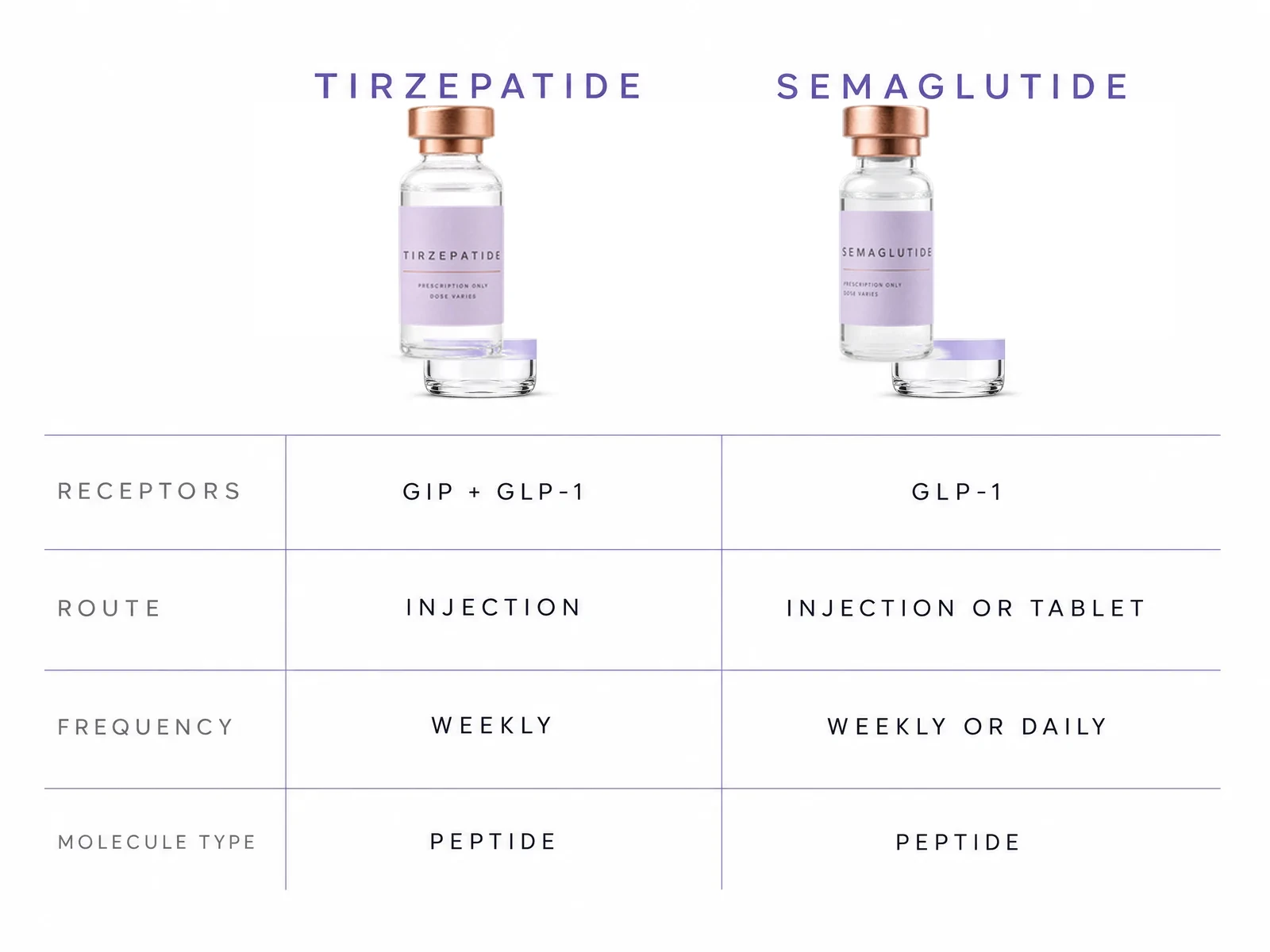
Tirzepatide vs semaglutide comes down first to mechanism: tirzepatide activates both GIP and GLP-1 receptors, while semaglutide targets GLP-1 alone. For patients comparing treatment options for weight management or glucose control, and for people exploring compounded medication options through telehealth, that difference can shape side effects, insurance considerations, and overall fit with a licensed clinician. This comparison looks at how they differ in mechanism, how branded-trial evidence is framed, safety including side effects and boxed warnings, what compounded means, and how to choose between them with a licensed clinician, since both require medical supervision. For a plain-language explainer of the tirzepatide molecule in compounded context, see what is compounded tirzepatide.
One gut-hormone signal versus two: the GLP-1 receptor difference
Semaglutide is a GLP-1 receptor agonist, so in tirzepatide versus semaglutide you are comparing one gut-hormone signal with two. Drucker reported in Cell Metabolism (2018) that these medications work through incretin hormones by reducing appetite, supporting blood sugar control, and slowing food movement through the digestive tract and gastric emptying to promote satiety. Tirzepatide is a dual agonist, a dual GIP (glucose-dependent insulinotropic polypeptide) and GLP-1 receptor agonist. Coskun and colleagues reported that dual-receptor design in Molecular Metabolism (2018), including work on subcutaneously administered tirzepatide. Tirzepatide’s dual receptor activation is a different receptor profile than one drug acting only on GLP-1. These gut hormones come from the gastrointestinal system and can affect insulin release, insulin response, food intake, and how the liver regulates sugar production. That mechanism is part of how semaglutide and tirzepatide compare, even though the clearest outcome data come from randomized controlled trials of FDA-approved products rather than animal studies. Two receptors is not the same as one. Neither compounded form is interchangeable with an FDA-approved manufactured product.
Those trial numbers belong to the branded products studied
Outcome figures from clinical trials of FDA-approved products belong to those branded products, at the studied regimens, in those populations. PinwellRx does not transcribe trial body-weight percentages onto compounded options. Head-to-head and pivotal branded-program results are reported in the New England Journal of Medicine, including SURMOUNT-1 (tirzepatide) and STEP-1 (semaglutide). Those papers describe branded-trial populations, regimens, and endpoints only. Comparative efficacy in that literature reflects studied branded use, not every product a reader may be considering, and not compounded preparations. A systematic review can help summarize that literature, and a network meta analysis can broaden the comparison across trials, but neither replaces head-to-head context or authorizes applying branded outcomes to compounded drugs. Real world data can also add perspective outside tightly controlled studies, though it is usually less clean than randomized data. Compounded drugs are not FDA-approved and do not undergo premarket review. The FDA has published concerns about unapproved GLP-1 drugs used for weight loss.
Same ingredient name is not the same product
A 503A pharmacy prepares a per-patient prescription. That is not the same as an FDA-approved manufactured drug. Same active-ingredient name is not the same product. For definitions and red-flag context, see what compounded means. A licensed clinician reviews your health profile, health history, overall health, personal or family history, and health goals before deciding on the right medication, or neither, especially when treating obesity or planning for chronic weight management. A healthcare provider may also watch how your body responds over time and adjust your treatment plan, since no single drug is automatically the right fit for every patient. Certain patients may not be good candidates because of boxed warnings related to thyroid C-cell tumors, including people with a personal or family history of medullary thyroid carcinoma or MEN2. Full refund if you are not prescribed.
Insurance coverage, before you pay
Insurance coverage depends on the medication, diagnosis, and plan rules, and patients may need to check with their insurance provider. Coverage often differs for diabetic patients, and it can also vary based on whether the prescription is for diabetes care or chronic weight management. Plans may also treat brand names differently from compounded options.
A licensed clinician reviews your health profile, health history, health goals, medical history, and family history. That decision is part of a personalized treatment plan for obesity management or diabetes care, not just a one-time prescription. There is no single right medication for everyone. People may regain weight after stopping either medication, so ongoing treatment is often needed to maintain benefits when a clinician continues therapy.
Patients with a personal or family history relevant to thyroid C-cell tumor risk may not be good candidates. Nationwide telehealth. Houston is HQ. Availability varies by state and is subject to clinician eligibility, prescribing requirements, pharmacy availability.
Which one you get is a clinician’s call
Start a consult. A licensed clinician decides between the two medications based on health, starting weight, diabetes needs, and side-effect risk, and may decline. Coverage often differs for diabetic patients versus people seeking weight-loss-only treatment. Rules may also apply differently to Wegovy, Zepbound, and other branded products than to compounded medications. Affordable Care Act plans typically do not cover weight loss medications. Medicare’s GLP-1 Bridge Program covers Wegovy and Zepbound for eligible enrollees under that program. Both tirzepatide and semaglutide require medical supervision, especially if switching after side effects. Both drugs carry boxed warnings and common side effects. Semaglutide also has cardiovascular-outcomes evidence in people with established heart disease on branded labeling. Educational content, not medical advice. Individual results vary.
Those are two different molecules. A clinician picks one, the other, a tablet, or none. The tirzepatide visit, if they go that way, is compounded tirzepatide online. The semaglutide visit, if they go that way, is compounded semaglutide online.