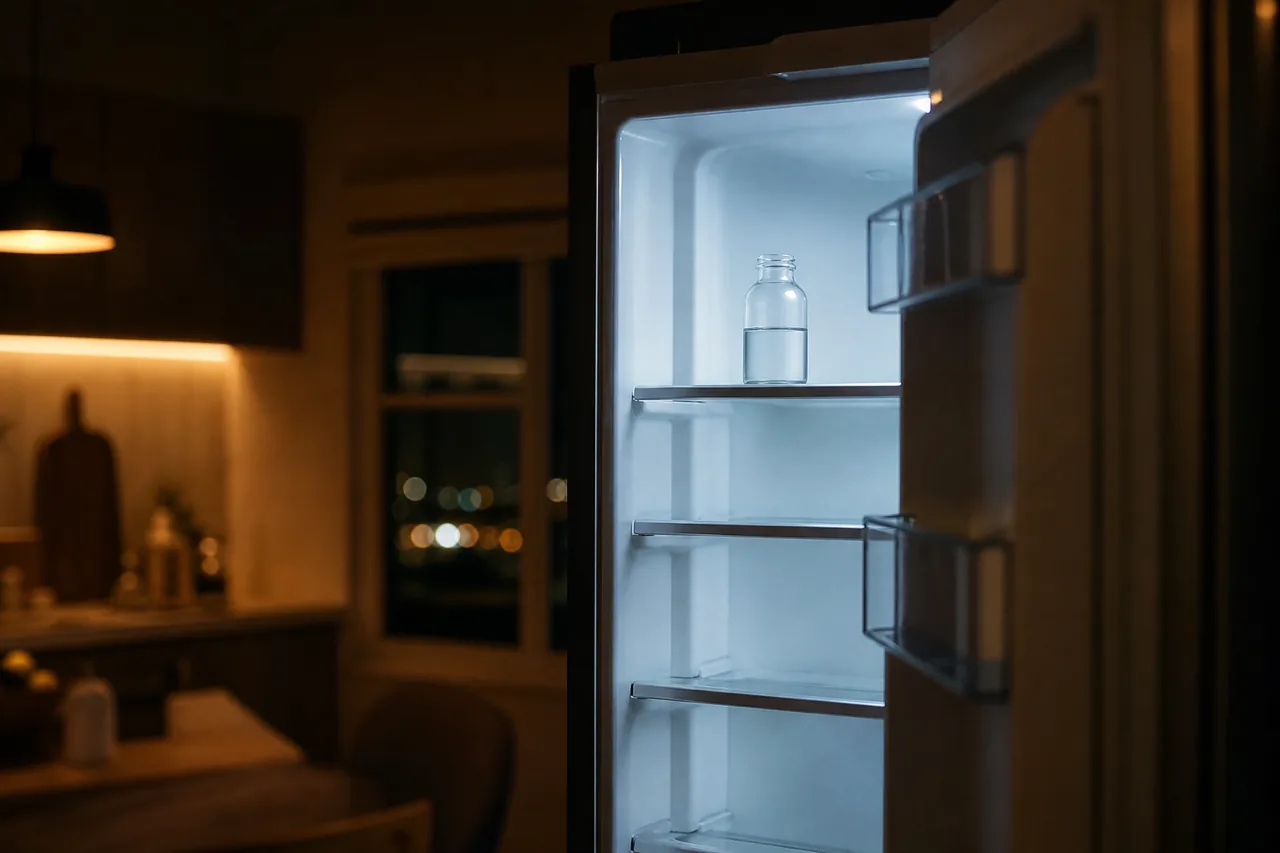
Why peptides are less forgiving than tablets
A peptide is a folded chain of amino acids, and its shape is its function. Heat, freezing, light and agitation can unfold or fragment it, and the damage is not visible in the vial.
Two clocks again
An unopened vial has one date; a reconstituted vial has a shorter in-use window. Both are on your label, assigned by the pharmacy that prepared it, and both apply only to your vial.
Where it must not go
The freezer, a freezer wall, direct contact with a frozen gel pack, a windowsill, a bathroom cabinet or a parked car. If a vial has frozen, do not use it even after thawing.
Sermorelin is a growth hormone-releasing hormone analogue: it signals the pituitary rather than supplying growth hormone.
Travelling with it
Hand luggage only, never the hold, in pharmacy packaging with the label attached, in an insulated case with a cool rather than frozen pack. Screening prescribed medication is routine.
If something has gone wrong
Do not use it and do not decide alone. Call the pharmacy printed on the label with how long, how warm and whether the vial was punctured. See the 30-second film answers for this medication.
How sermorelin works with your own pituitary
Sermorelin is a synthetic fragment of growth hormone-releasing hormone, the signal the hypothalamus normally sends to the pituitary. It binds the GHRH receptor and prompts the pituitary to release growth hormone that your body makes itself. That is the mechanistic distinction from administering recombinant HGH, which supplies the hormone directly and overrides the signalling loop. Because sermorelin works upstream, the body’s own negative feedback remains in place, and release stays pulsatile rather than continuous. This is also why it is not an anabolic steroid: steroids act on androgen receptors, a completely separate pathway. Sermorelin is not a steroid spells that out. According to FDA records, sermorelin was previously approved as a diagnostic agent; current compounded use is not FDA-approved.
Compounded medications are not FDA-approved.
Why timing and administration matter
Growth hormone release is naturally pulsatile and largest during early deep sleep. That is the reasoning behind the common instruction to administer sermorelin at bedtime on an empty stomach, since elevated glucose and insulin blunt GH release. It is a mechanistic rationale rather than proof of a better outcome, and your clinician’s instructions govern. Preparations are typically subcutaneous, with site rotation, and reconstituted product is refrigerated per the pharmacy’s instructions. Where to inject sermorelin and refrigeration cover the handling detail. If your schedule makes bedtime dosing impractical, that is worth raising rather than improvising, because consistency generally matters more than any single ideal time.
What the evidence supports, stated plainly
Sermorelin reliably raises growth hormone and IGF-1 in studies, which is a pharmacodynamic result rather than a clinical outcome. What has not been established in adults using compounded sermorelin for wellness purposes is that those raised levels translate into specific improvements in body composition, sleep quality, recovery, or ageing. Compounded sermorelin is not FDA-approved, and FDA does not review compounded preparations for safety, effectiveness, or quality before marketing. Anyone describing guaranteed results is telling you something the evidence does not support. The reasonable framing is that the mechanism is well characterised, the downstream clinical picture is not, and a licensed clinician weighs that uncertainty against your history before deciding whether treatment is appropriate.
What happens if you stop
Because sermorelin stimulates your own pituitary rather than replacing a hormone, stopping does not create the dependency picture associated with exogenous hormone administration. Growth hormone and IGF-1 levels would be expected to return toward your untreated baseline over time, and any effects attributable to the elevated levels would likewise recede. There is no established taper requirement, but discontinuation is still a clinical conversation: your clinician may want to reassess what you were treating, what changed, and whether anything else in your history warrants follow-up. Stopping sermorelin covers the practical side. Do not stop or restart a prescription based on something you read; tell the clinician who prescribed it.
You have read enough. A clinician reads your history and tells you honestly whether this fits.
Frequently asked questions
Can I keep it at room temperature for a day?
Check your label and call the pharmacy. Allowances differ by formulation and are not something to infer from a general rule.
Does shaking it matter?
Handle it gently. Agitation can damage peptides; roll rather than shake unless your instructions say otherwise.
Is sermorelin a steroid?
No. Sermorelin is a growth hormone-releasing hormone analogue that acts on the GHRH receptor to prompt your own pituitary. Anabolic steroids act on androgen receptors, an entirely separate pathway.
Is sermorelin FDA approved?
Sermorelin was previously approved as a diagnostic agent. Compounded sermorelin prescribed for wellness purposes is not FDA-approved, and FDA does not review compounded preparations for safety, effectiveness, or quality before marketing.
Does sermorelin work?
Sermorelin reliably raises growth hormone and IGF-1 in studies, which is a pharmacodynamic result. Whether that produces specific clinical improvements in body composition, sleep, or recovery is not established.
What happens when you stop taking sermorelin?
Because it stimulates your own pituitary rather than replacing a hormone, growth hormone and IGF-1 would be expected to return toward your untreated baseline. Discuss discontinuation with the clinician who prescribed it.
Start with a pharmacy that labels it properly
Prescribed if appropriate by a licensed clinician, shipped cold-packed. Rx only.
Rx only. A licensed clinician decides whether treatment is appropriate and may determine that no treatment, or a different treatment, is right for you. Compounded medications are not FDA-approved and are not reviewed by FDA for safety, effectiveness, or quality before marketing. Individual results vary.
Sources
Clinical trials listed below evaluated FDA-approved products at the doses studied. They are cited as published science, not as evidence about any compounded preparation, which is not FDA-approved and has not been evaluated by FDA for safety, effectiveness, or quality.
- Peer-reviewedPrakash A, Goa KL. Sermorelin: a review of its use in the diagnosis and treatment of children with idiopathic growth hormone deficiency. BioDrugs 1999;12:139-157
- ReferenceUSP General Chapter <797> Pharmaceutical Compounding, Sterile Preparations
- FDA databaseDrugs@FDA: sermorelin acetate records
- FDA guidanceFDA: Compounding and the FD&C Act, Section 503A
Spotted something inaccurate? Report an error – corrections are logged per our editorial standards.
More on Sermorelin
Same medication, different question.